
Blog
How to Verify Bodyguard Credentials in Egypt Before Hiring

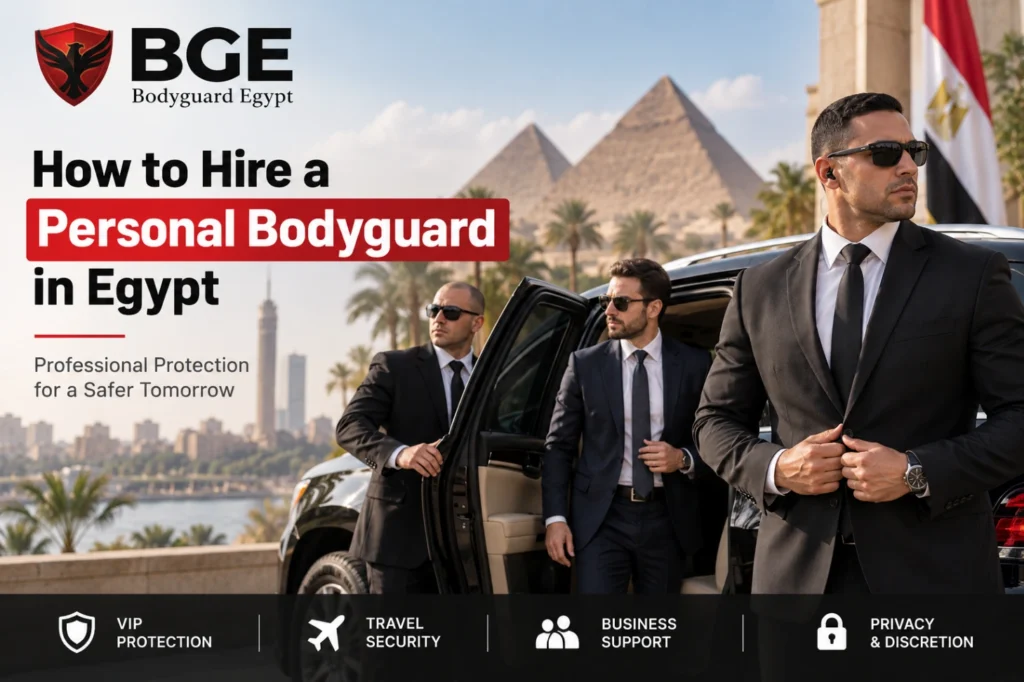
Hiring a personal bodyguard in Egypt starts with understanding what the assignment actually requires. A single airport arrival, a day of business meetings, a private event and an itinerary across several locations are different situations. Before you compare service providers, describe the purpose of the assignment, its approximate duration and who will coordinate changes. Clear requirements make it easier to compare the scope of work without relying on marketing claims.
1. Describe the assignment before contacting a provider
Start with a short, practical brief: the city, general type of activity, expected date and time range, number of people involved and approximate number of locations. You do not need to share a private residence address, a precise travel route or personal identification documents in an initial inquiry. Keep sensitive details for an appropriate, verified channel when they become necessary.
A request for “VIP security” is too broad on its own. It might refer to escorting a guest between venues, accompanying someone during meetings or discussing privacy needs for a public appearance. Explain the actual circumstances instead of assuming that a service name defines the number of personnel, equipment or outcome.
2. Check what a personal bodyguard service does and does not cover
Personal accompaniment concerns the movement and agreed activities of a person or group. It should not automatically be confused with venue access control, crowd management, event security or the protection of an entire building. Those responsibilities may sit with different providers or the venue operator.
Ask where the assignment begins and ends, which locations are included, how waiting time is handled and who is responsible for changes. Clarify whether accompanying a person into a restricted area is possible under the venue’s rules. Do not assume that a private escort grants additional access rights.
3. Ask for evidence behind qualifications and licensing claims
If a provider describes its personnel as licensed, certified or specially trained, ask what the claim means in the context of the proposed work and request documents that can be checked with the appropriate issuing body. Requirements may vary with the activity and applicable rules. A badge, uniform, photograph or testimonial is not a substitute for independent verification.
Similarly, avoid requesting confidential information about previous clients as proof of experience. Ask instead about relevant responsibilities, supervision, communication procedures and the information that can be confirmed without exposing someone else’s privacy.
Checking bodyguard credentials in Egypt: a practical verification checklist
People searching for a licensed bodyguard in Egypt should avoid assuming that a badge, website logo, uniform or marketing label is itself proof of any legal authorization. Different activities and services may be subject to different requirements, and the applicable rules should be checked against up-to-date official information or advice from a qualified local professional. No single credential should be presented as universally sufficient without examining the specific service proposed.
Identify the legal entity offering the service
Ask for the registered name of the business or provider you would be dealing with, the name of the person responsible for the assignment and a clear statement of what the provider will do. If a firm claims that it holds a registration or license, request enough information to check that claim through the relevant issuing or public authority, where verification is available. A verbal assurance is not a document check.
Match any qualification to the actual assignment
Ask what kind of training, experience or professional authorization is being claimed and how it relates to the proposed work. Personal accompaniment, access control, armed services, event arrangements and transportation do not automatically have identical legal or practical requirements. Avoid assuming that a credential from one field permits every activity.
Confirm identity and responsibility without collecting unnecessary personal data
It is reasonable to ask how the provider establishes the identity of personnel assigned to your request and who supervises them. You do not need to publish anyone’s identity documents or private history to evaluate the service. Request verification through suitable channels and keep records accessible only to the appropriate people.
Ask for a written scope and applicable conditions
A useful agreement or proposal identifies the assignment, approximate locations, duration, contact person, limits of responsibility, applicable venue permissions and the process for altering the schedule. Verify any claims that depend on third-party authorization independently. Written clarity does not remove every risk, but it helps prevent misunderstanding about what has and has not been arranged.
Warning signs that deserve further questions
- Pressure to agree before you can review basic service details.
- Unverifiable claims about licensing, training or professional status.
- Promises of absolute safety or unrestricted access to venues.
- A refusal to clarify who is responsible for the assignment.
- Requests to send sensitive identity details or a precise private itinerary through an unverified channel.
These signs are reasons to seek clarification, not proof of wrongdoing. The aim is to make a measured decision based on verifiable information rather than advertising alone.
4. Plan communication and privacy
Identify one person who will confirm the schedule and approve changes. For a business visit, this might be an office coordinator; for a conference, an event organizer; and for a private appointment, a designated contact. A single communication route reduces conflicting instructions when meetings run late or plans change.
Share information proportionately. An initial request may only need the city and a general itinerary. Exact meeting points, accommodation details and personal identity information should be shared only when there is a clear need and a suitable channel. Ask who can access that information and how it will be handled.
5. Compare proposals by scope, not slogans
When reviewing responses, compare the duration, number of people, locations, waiting periods, restrictions, point of contact, conditions for extending the assignment and responsibilities excluded from the agreement. Two proposals using the same phrase, such as “private bodyguard”, may describe very different commitments.
Do not treat promises of guaranteed safety or claims of being the “best” provider as measurable evidence. The useful questions are what will be done, by whom, under which conditions and how changes will be approved. This guide does not publish assumed rates, discounts or availability.
6. Consider the type of visit or event
Business meetings and site visits
Make clear whether the itinerary involves one office or several locations, and identify the contact who can confirm a revised schedule. Discuss any access requirements with the relevant venue rather than assuming an escort can enter every restricted area.
Public appearances and conferences
Separate personal accompaniment from the responsibilities of event organizers and venue security. Explain whether the request concerns arrival and departure, movement between scheduled appearances or another clearly described part of the program.
Family or visitor accompaniment
Describe the number of people, broad locations and time period. If the visit involves special requirements, raise them directly and clarify what arrangements can actually be provided before assuming they are included.
7. Questions to ask before agreeing
- What is the exact scope of accompaniment and which tasks are excluded?
- What information is needed before the assignment can be confirmed?
- Who coordinates the schedule, delays and location changes?
- Which qualifications or licenses are being claimed, and how can they be verified?
- How are privacy and sensitive itinerary details handled?
- Which venue rules or permissions may affect the work?
- How are revisions, postponement and cancellation discussed and documented?
8. Common questions about hiring a bodyguard in Egypt
Is every security assignment the same?
No. The requirements for accompanying one person can differ significantly from those of an event or a fixed site. Define the assignment before comparing proposals.
Does “VIP protection” guarantee a particular level of safety?
No service label alone establishes the scope of work or guarantees an outcome. Ask what the proposed arrangements actually cover.
Can I ask about licensing?
Yes. If licensing or certification is claimed, request the relevant details and verify them through appropriate sources for the type of service being considered.
Should I send my full itinerary immediately?
It is usually better to start with general requirements. Share sensitive details only when needed and through a channel you have verified.
How do I contact Gard Egypt about a possible assignment?
Prepare a concise brief with the city, type of appointment, duration and number of people, then use the contact page to ask what information and arrangements are needed. You can also review the services overview before contacting the team.
A practical starting point
The goal of a good inquiry is not to choose a provider from a single headline. It is to define the task, verify relevant information, protect the privacy of the people involved and understand the boundaries of the proposed service. A clear brief creates a more useful conversation and helps prevent misunderstandings before an appointment is confirmed.